Feb 11, 2012

WHAT MAKES THEM SO SPECIAL?

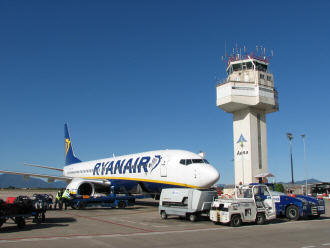
Ryanair's director Michael O'Leary threatened AENA (the airline governing body) with cutting the number of flights connecting the UK and Ireland with Reus and Girona airports unless AENA reduces costs for running from small airports. Reus and Girona are two airports located on the east coast of Spain.

Before Ryanair started flying from and to these airports there were barely any flights compared to some years later. Ryanair started flying to Reus in 2004, the increasment from 2003 to 2004 is quite noticeable.

INCREASMENT OF THE NUMBER OF PAX. FROM YEAR 1994 UNTIL YEAR 2010.

YEAR Pax.   Anual Increasment (%)
1994  323.515  -
1995  482.603  +49,2
1996  459.124  -4,9
1997  525.903  +14,5
1998  569.040  +8,2
1999  626.990  +10,2
2000  725.006  +15,6
2001  739.469  +2,0
2002  759.864    +2,8
2003  845.009 +11,2
2004  1.136.160 +34,5
2005  1.380.664   +21,5
2006  1.379.316 -0,1
2007  1.305.352 -5,4
2008  1.275.956 -2,3
2009  1.702.741   +33,4
2010  1.415.570   -16,9
Source: Reus Airport, AENA.

He is currently negociating with AENA over reducing costs.

Is this fair? Should an airline even have the right to negotiate with the airline governing body over paying less when the rest of the airlines won't even be listened to? What makes them so special?

Jan 28, 2012

Adiós Spanair


Hoy es un día triste para España, la aviación comercial y la historia de nuestras aerolíneas. Desaparece la veterana Spanair de los cielos para siempre. Las razones obvias son una crisis mundial que se ha llevado por delante a millones de empresas en todo el mundo y que ha dañado mucho el sistema económico mundial. Pero, ¿qué otras razones se nos ocurren para explicar lo que ha pasado? El crecimiento de algunas aerolíneas que han visto claro como abrirse hueco, ha ido poco a poco quitando espacio para otras que llevaban años volando. Aerolíneas como Ryanair, que aprovechándose de este libre mercado enloquecido han recibido mucho apoyo por parte de los usuarios. Ésta es una compañía extranjera que vive de continuas trampas, todo con resquicios legales de tal forma que aparentemente no hacen nada malo. Pero esto se demuestra que es falso en un día como hoy, en que desaparece Spanair. Si seguimos financiando a aerolíneas de bajo coste lo único que conseguiremos será hacer que todas las demás desaparezcan. Lo que hoy parece tan barato se convertirá en algo impensable en un futuro, si se permite que las demás dejen de poder volar.
Quizás merezca la pena pensárselo dos veces. ¿No creen?

Jan 18, 2011

Biofuel for Aircrafts


Lufthansa first airline to use Biofuel on passenger flights

There have been quite a few airlines testing out different biofuels, but none that have run biofuels on a long-term basis during scheduled passenger service. Starting in April 2011, Lufthansa will start a six month trial using an Airbus A321 on scheduled flights between Hamburg and Frankfurt using biofuel.
Only one of the A321′s engines will be using a 50-50 mix of biofuel and normal aviation fuel. They hope to use this six months to see how the use of biofuel will affect maintenance and engine life. The A321 will have a unique set up since it will only fly this route and only be fueled in Hamburg. Normally aircraft are used on different routes and can be fueled at almost any airport.
During the six month trial, Lufthansa expects to save about 1,500 tons of CO2 emissions. “Lufthansa will be the world’s first airline to utilize biofuel in flight operations within the framework of a long-term trial. This is a further consistent step in a proven sustainability strategy, which Lufthansa has for many years successfully pursued and implemented,” said Lufthansa Chief Wolfgang Mayrhuber.
This project, that Lufthansa is calling “burnFAIR,” is being funded in part by the German government. The government is investing about $3.3 million (2.5 million Euros) into the project, where Lufthansa is investing about $8.7 million (6.6 million Euros). The goal is to find a viable alternative to standard aviation fuel that can power  airlines around the world with less emissions and be sustainable.
The use of biofuel is one element in a four-pillar strategy aimed at reducing overall emissions in air traffic at Lufthansa. Environmental goals can only be achieved in the future with a combination of various measures, like ongoing fleet renewal, operational measures such as engine washing and infrastructural improvements. Cheers to Lufthansa taking this next step, I will be very interested to see how it works out.


________________________________________________________________________________

About Biofuels
Researchers at the DLR Institute of Combustion Technology in Stuttgart are developing new fuels for the aviation industry. By 2030, for instance, oil-based kerosene could be replaced by fuels produced entirely from biomass. At the same time, the liquids are to be so tailored to combustion in aircraft engines, that they reliably supply more performance at lower levels of emissions and soot.

On the path towards the optimal, as climate neutral as possible designer kerosene, the team of approximately 20 researchers around Institute Director Professor Dr. Manfred Aigner uses test stands such as a high pressure burner or a so-called shock tube. The experiments are accompanied by computer models to coherently simulate the entire reaction sequence during a combustion process. “We can influence up to 50 different parameters such as, for example, ignitability, in order to obtain a fuel that is better than the kerosene licensed these days”, says Aigner. The basis for synthetic fuels is the “Fischer-Tropsch synthesis” invented already in the 1920s in Germany. With this method, natural gas (GtL: gas to liquid) initially can be converted into synthesis gas by adding oxygen and water vapour and in a next step into liquid carbon hydrides. Instead of natural gas, one can also use coal (CtL: coal to liquid) or biomass (BtL: biomass to liquid) as a substitute for oil. The work of the Stuttgart researchers is followed internationally with great interest. Currently, they are working on a plan for alternative fuels together with partners in the EU project ALFA-BIRD. In addition, there are numerous cooperations with, amongst others, Shell, Rolls-Royce and the technology centre Qatar Science & Technology Park.

Jan 12, 2011

RYANAIR: fuel shortages


Low-cost? 

Your safety shouldn't be that cheap.


Ryanair pilots have denounced as “insane” attempts to pressurise them into flying with less fuel by imposing a cap on their safety reserves.
The low-cost airline is saving money by curbing the discretionary rights of pilots to request extra fuel.
The disclosure, made in internal company documents seen by The Sunday Times, has led to claims that the safety of passengers is being compromised as the price of oil soars.
Details of Ryanair’s policies emerged as the Civil Aviation Authority revealed that the number of emergencies declared in British airspace because of fuel shortages had doubled in five years. Last year, 27 planes were given the right to make priority landings, up from 11 in 2003.
There were also 18 “May-days” caused by fuel shortages in the same period, when British airports had to go on an emergency footing with fire engines on the runway.
Under European rules, every plane must carry a “contingency” load of about 5% of a trip’s fuel, and enough to divert to an alternative airport. Across the airline industry, captains also have a duty to anticipate delays from headwinds, storms and rerouting, and to request extra fuel to cope with this.
Pilots at Ryanair, Europe’s largest low-cost airline, must now abide by a limit of 300kg of extra fuel, costing £180. This provides about five minutes of extra stacking time for a Boeing 737.
Evan Cullen, a pilot with 19 years’ experience and president of the Irish Air Line Pilots’ Association, said commercial pressure on pilots to pare down the fuel they carry was compromising safety.
The internal Ryanair memo, sent to pilots in May, reveals that the company insisted that any request by a captain for extra fuel should be the “exception”. It referred to the 300kg maximum.
The memo shows that Ryanair is issuing warning letters to pilots who request extra fuel without explanation. Pilots claim such letters can be used in disciplinary proceedings.
The pilots have responded by complaining in anonymous postings on the Ryanair European Pilots’ Association website.
One says: “It is insane to push pilots to fly with the minimum fuel and take the risk of ending with a low fuel situation and maybe no place to go because the only diversion airport within reach will be mobbed by other aeroplanes.”
Pilots say Ryanair ranks them according to how much extra fuel they use. A spokesman for the airline rejected the pilots’ claims as “anonymous, unverified and inaccurate”. He said: “No pilot is allowed to fly with minimum fuel as these clowns claim.”
He admitted, however, that pilots were allowed extra fuel only in “exceptional cases”. He said Ryanair had suffered one Mayday in the past three years caused by fuel shortages.


http://business.timesonline.co.uk/tol/business/industry_sectors/transport/article4641399.ece
________________________________________________________________________________


Incident: Ryanair B738 at Alicante and Valencia on May 14th 2010, fuel emergency


A Ryanair Boeing 737-800, registration EI-DYX performing flight FR-8384 from London Stansted,EN (UK) to Alicante,SP (Spain), was on approach to Alicante's runway 10 but went around due to weather conditions. The crew subsequently attempted an approach to runway 28 but went around again due to winds and decided to divert to Valencia (72nm north of Alicante) declaring PAN being below the final fuel reserve. While on approach to Valencia the crew declared MAYDAY and performed a safe landing on Valencia's runway 12.

The Spanish CIAIAC reported, that following the landing in Valencia remaining fuel was measured: 440kg of fuel were found in tank 1 (left hand), 470kg in tank 2 (right hand) and 0kg in center tank. The airplane was refueled and continued to Alicante. An investigation has been initiated.

The airplane reached Alicante with a delay of 2:25 hours.


Dec 25, 2010

Damage to the A380


A QANTAS A380 was a flying wreck after an engine exploded a few weeks ago, shooting metal through fuel tanks. 
Last week's mid-air emergency off Singapore also badly damaged a wing, which may have to be replaced.
The Herald Sun can reveal the full list of damage as the big jet was nursed back to Singapore on three engines.
When it touched down the fuel systems were failing, the forward spar supporting the left wing had been holed and one of the jet's two hydraulic systems was knocked out and totally drained of fluid.
Sources compared the A380 to the Memphis Belle, the World War II bomber that struggled back to England from Germany on its final mission and became the subject of an award-winning 1990s Hollywood movie by the same name.
Richard Woodward, vice-president of the International Air Pilots' Federation, told the Herald Sun yesterday that the lesson from the near disaster was the value of an experienced flight crew.
"There was a wealth of experience in the cockpit, even the lowest ranked officer on board had thousands of hours of experience in his former role as a military flying instructor," said Capt Woodward, himself an A380 pilot on leave from Qantas.
As another senior pilot said: "It is bad enough for an engine to explode in mid-air let alone lose so many secondary systems".
Investigators found shrapnel damage to the flaps, a huge hole in the upper surface of the left wing and a generator that was not working.
The crew could not shutdown the No. 1 engine using the fire switch.
As a result the engine's fire extinguishers could not be deployed.
Captain Richard de Crespigny, first officer Matt Hicks and Mark Johnson, the second officer, could not jettison the volume of fuel required for a safe emergency landing.
With more than 80 tonnes of highly volatile jet kerosene still in the 11 tanks -- two of which were leaking -- they made an overweight and high speed approach to Changi Airport.
Without full hydraulics the spoilers -- the hinged flaps on the front of the wings -- could not be fully deployed to slow the jet.
The crew also had to rely on gravity for the undercarriage to drop and lock into place.
On landing they had no anti-skid brakes and could rely on only one engine for reverse thrust -- needing all of the 4km runway at Changi to bring the jet to a stop.
The three crew have been interviewed by Australian investigators and cleared to return to duties.
Industry sources said the damage will almost certainly put the airline's flagship jet -- the Nancy Bird-Walton -- out of service for months.
Investigators found that an oil fire may have caused the engine to explode.
Details of the stricken jet's problems were revealed yesterday in an emergency directive by the European Aviation Safety Authority.
The authority made it mandatory for airlines with the now suspect Rolls-Royce Trent 900 engines to make checks for excess oil.
If not detected, excess oil can cause a fire and ultimately result in "uncontained" engine failure, with potential damage to the aeroplane and to people or property on the ground.
Qantas made it clear it will keep its six superjumbos grounded indefinitely and has rearranged flight schedules using substitute aircraft.
"The specific checks mandated by the directive were already being carried out by Qantas in conjunction with Rolls-Royce," it said.
"Qantas's A380 aircraft will not return to service until there is complete certainty that the fleet can operate safely."

WHAT WENT WRONG ON QF32
Damage to the A380
1 Massive fuel leak in the left mid fuel tank (there are 11 tanks, including in the horizontal stabilizer on the tail)
2 Massive fuel leak in the left inner fuel tank
3 A hole on the flap fairing big enough to climb through
4 The aft gallery in the fuel system failed, preventing many fuel transfer functions
5 Problem jettisoning fuel
6 Massive hole in the upper wing surface
7 Partial failure of leading edge slats
8 Partial failure of speed brakes/ground spoilers
9 Shrapnel damage to the flaps
10 Total loss of all hydraulic fluid in one of the jet's two systems
11 Manual extension of landing gear
12 Loss of one generator and associated systems
13 Loss of brake anti-skid system
14 No.1 engine could not be shut down in the usual way after landing because of major damage to systems
15 No.1 engine could not be shut down using the fire switch, which meant fire extinguishers would not work on that engine
16 ECAM (electronic centralized aircraft monitor) warnings about the major fuel imbalance (because of fuel leaks on left side) could not be fixed with cross-feeding
17 Fuel was trapped in the trim tank (in the tail)creating a balance problem for landing
18 Left wing forward spar penetrated by debris


Thanks for reading;)